On September 12, 2004 elements of my CAAT section were attached to a company sized tank unit for a large operation. Twenty four tanks (I believe from 1st Tank Battalion, though I could be wrong) lined up on the north side of Fallujah as part of a series of “Tank Demonstrations” that our battalion had been running, These demonstrations were part of a campaign to confuse the defenders in Fallujah about where and when the imminent coalition assault on the city would come from.
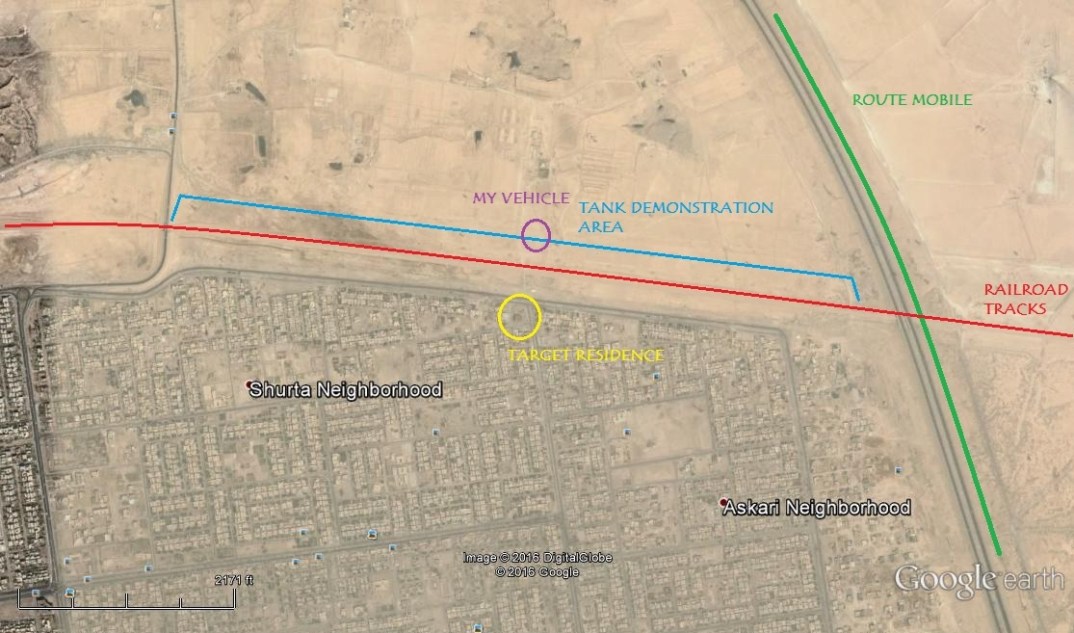
I was not in my regular vehicle, as the operation called for support from a vehicle with a MK-19 Automatic Grenade Launcher rather than the M2 mounted on my own vehicle. I decided I would tag along on Cpl Onsgaurd’s vehicle with LCpl Byro, and Cpl Kephart from Weapons Company 3rd Battalion, 5th Marine Regiment who had recently started our relief in place (RIP). Here is roughly how we were set up:

We moved in at dawn from Camp Baharia on MSR Mobile and lined up on a raised dirt road that paralleled the train tracks on the north side of the city. My recollection is that we were essentially covering the whole north eastern half of the city. The tanks spread out online with about 50-100 meters between tanks, all facing south into the city. I positioned my vehicle in the center of the tank’s line near a dirt road that ran south over the railroad tracks and into the city. Soon after we stopped the shooting started.
The fight started as hidden snipers took single shots at the tanks lined up. In return the tanks used their excellent optics to locate firing positions, and then used machine guns initially to engage those positions. The firing started sporadically both to our east and west, nothing initially in front of us. After about 30 minutes of sporadic firing from the city, we heard the first mortar rounds firing. They were inaccurate, but we didn’t want to give them time to zero in on our positions. Our first engagement on the target house began when the tanks identified a mortar tube in partial defilade on the roof of the house. Several bursts of .50 caliber machine gun fire and a few tank main gun rounds failed to reduce the mortar site, and instead invited small arms fire from the residence.
Let me describe exactly what we were looking at. This was a three story residence with a large courtyard between us and the building. The courtyard was surrounded by 6 to 8 foot tall reinforced concrete jersey barriers (which I suspect were further reinforced with sandbags or something to that effect). The building itself also appeared to have been significantly reinforced. Most of the time when a tank main gun round hit a wall it would destroy a large portion of the wall. In this case the rounds were punching holes, but they weren’t much larger than the rounds themselves, indicating a strong possibility that the walls were lined with probably a dual layer of sand bags. We would later determine that in the courtyard there was at least one, maybe several bunkers dug into the ground. This is all important to note because a pretty significant amount of munitions was expended on this one compound.
Our vehicle engaged in the gunfight as the tanks started feeding us targeting information by use of the “grunt phones”
We used the MK-19 to engage targets that the tanks couldn’t (the main reason they had wanted us along). Because of the arcing flight of the Mk-19 rounds we could lob them over walls and into individual windows.
When the main gun rounds, .50 caliber machine guns, and some very accurate fire from our MK-19 failed to stop the increasing amounts of small arms fire coming from the compound we called in the first of 3 airstrikes. Here is video of the second airstrike:
After the third airstrike on the compound the small arms fire died off. Whether the fighters inside had been wounded, shell shocked, or had just run out of ammo is not known, but they had stopped firing for the moment.
During this brief lull a single vehicle drove out of the city, it was quickly identified as an ambulance. We held our fire, and watched it drive up to the target compound. The ambulance backed up to the wall surrounding the courtyard, where several of the jersey barriers had been obliterated by tank rounds. The driver got out of the vehicle and opened up the back doors. He then walked back to the drivers seat and got in.
This part is still crystal clear in my minds eye. Three men came running out of the courtyard, presumably from an underground bunker, with medium machine guns and an RPG in hand. They jumped into the waiting ambulance and slammed the doors shut as it accelerated away from the courtyard. I stared in shock that armed fighters had run brazenly in front of over a dozen tanks which had been pulverizing their fortified position. they had balls. The ambulance immediately turned south into the roadway running into the city. They didn’t make it. The tank to the left of us opened up with its coax machine gun, tracers punched into the driver’s side of the vehicle. It swerved into the rubble to the right and into the damaged wall of the compound. Just as it stopped, a tank main gun round hit the building just above it, blowing smoke and debris all over the ambulance. Before the vehicle was completely enveloped in smoke, a second main gun round made a direct hit on the ambulance. There was a flash of light with the metal on metal impact of the high explosive round. Then I finally hit the record button on my camera. Here is the immediate aftermath:
It was a pretty clear cut and dry shoot. The bad guys were armed, and did not appear to be injured in any way. They had sprinted to the ambulance. The driver of the ambulance clearly had made a plan to use the ambulance’s protected status to recover the fighters.
CNN apparently didn’t get the memo.
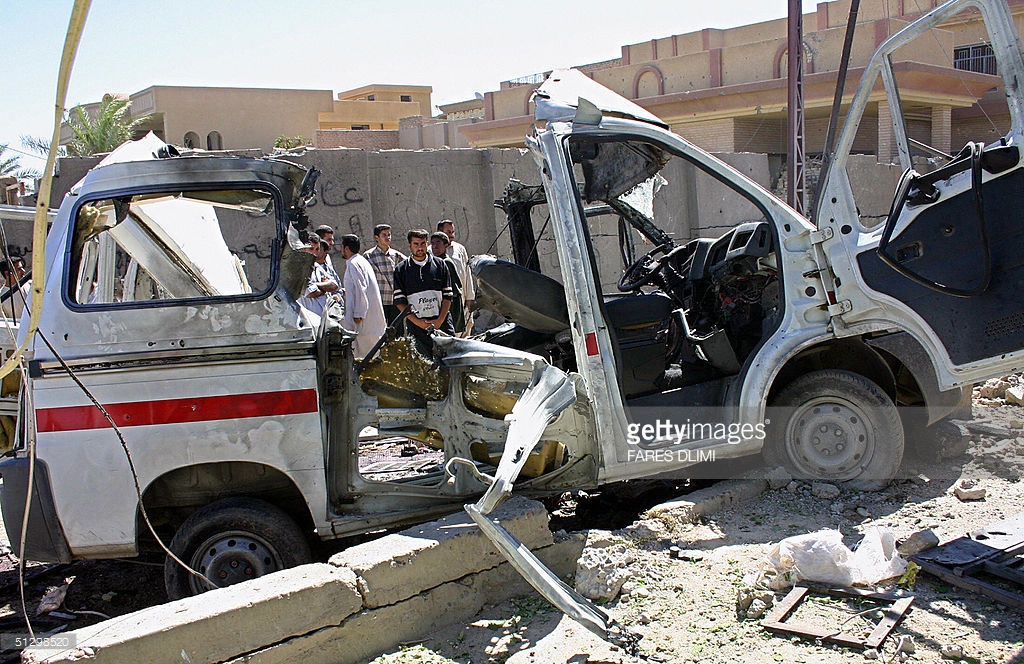
At Camp Baharia the next morning for breakfast, I saw a picture of the ambulance on the television. CNN was reporting that U.S. Marines had dropped a bomb on an ambulance carrying wounded women and children to a hospital. I was livid. It was very clearly the exact same ambulance with the exact same blast damage from the tank main gun round, and still sitting on the exact pile of rubble where it had stopped after the tanks hit the driver with the coax. Here is the image and accompanying caption:
Embed from Getty ImagesIraqis look at a destroyed Iraqi Red Crescent ambulance following a US air strike in the restive city of Fallujah, 13 September 2004. At least 15 people were killed and 20 wounded in a US air and ground assault on alleged Al-Qaeda operatives in Iraq’s notorious flashpoint city of Fallujah, medics said. ‘So far we received 15 bodies. Among them is an ambulance driver and two nurses, plus five wounded who were in the ambulance when it was attacked,’ said Falah Abdullah, an undertaker at the cemetery in Fallujah. AFP PHOTO/Fares DLIMI
 Gunsmoke Journal
Clinton News Network 😂
I love hearing y’all giggle! Omg I always want to know who the voices belong to. I think I heard Byro referencing the flag.
Glad to see the posts back again. Semper Fi
LikeLike
Byro and Onsgaurd were doing most of the talking, the other voice is Cpl Kephart with 3/5 who was doing a relief in place with us.
LikeLike
Weird. I just found this.
I was the tank that smoked that ambulance. I was the TC of Blue 4, the Plt Sgt of 3rd PLT, Bco, 1st Tank Bn.
Couple of corrections:
1. We had 14 tanks present, which is a single company.
2. My tank got the tube as well, but I didn’t have a shot into where the cache of ammo obviously was.
3. As he says in the footage; the badguys jumped out of the ambulance first. They were reenforcments. Once I sent a burst of coach into them, they jumped back in and tried to get away.
Both my Lt and I sent main gun their way. He missed, I didn’t. The shots were almost simultaneous, but you could tell who got it by the angle at which it exploded.
1st Lt Andrew Karl Stern was killed 4 days after this footage.
Interesting side note: the operation was to try to get Zarqawi to come out to fight so he could be target. He fled the city, but his No 1 and 2 guys were in that ambulance.
B. W. Smith, MSgt(ret)
LikeLike
Was Lt stern killed by the roadside bomb near route mobile and the railroad tracks? I remember that happening. And I’ll take your word for the actual count of tanks being 14, a company sounds right. Either way, it was a hell of an impressive lineup. I’m t was a pleasure working with you guys. Semper Fi!
LikeLike
I was the company commander for the Tank Company on this incident. This is pretty much how it happened.
And GySgt Smith. Sup dude.
LikeLike
Tanks are badass, I’m sorry to see the Corps is moving away from them now.
LikeLike